EMS Needs Mass Advocacy: My Journey from the Field to National Leadership

Updated: Apr 30
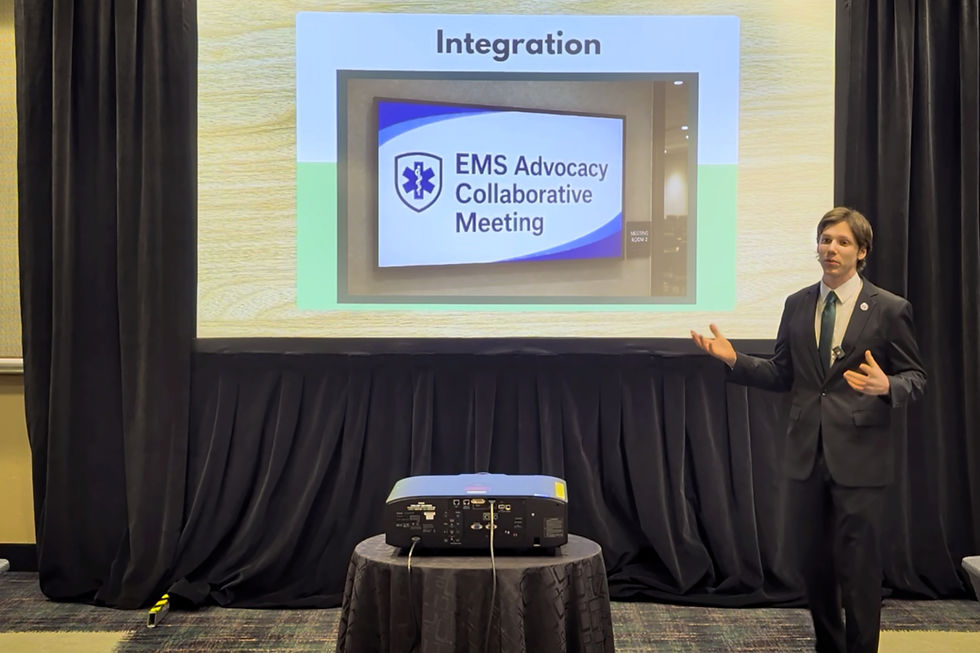
I never expected to find myself giving a presentation on grassroots advocacy in emergency medical services.
But last week that's exactly what happened. I stood in front of national EMS leadership at the American Ambulance Association's annual conference in Las Vegas and made the case that our industry needs community organizers as much as it needs clinicians and lobbyists.
I'm still kind of amazed I was there.
How I Got Here

My journey in EMS started two years ago when I joined Royal Ambulance as an EMT, fresh out of college, with plans to become a paramedic firefighter. Within my first week of field training I came down with a serious health condition, unrelated to work, that effectively ended my clinical career before it started.
After recovery I reached out to Royal looking for a way to stay connected to the work. They found one. I started part time in a growing Government Affairs department, and a year ago that became a full time role that now includes employee engagement and external communications.
It's a lot of hats. But there's a through line.
Before EMS, There Was Politics

Before EMS I was in politics. I ran for San Jose City Council at age 18 and for mayor of San Jose at 21, one of the largest cities in the country. Those weren't resume builders. I ran because I genuinely believed, and still believe, that my generation has inherited a set of challenges that demand new kinds of leaders from new kinds of backgrounds. Climate change. Housing. Transportation. Economic instability. I showed up to those races not knowing if I'd win, but knowing I had something to say.
EMS was supposed to be a different kind of showing up. Fewer speeches, more action. Turns out the two aren't as separate as I thought.
What Working in EMS Policy Taught Me

Working in EMS policy opened my eyes fast. The workforce is burning out. Reimbursement rates haven't kept pace with the actual cost of care. Agencies are understaffed and under-resourced at precisely the moment when demand is accelerating. More aging adults. More frequent disasters. More gaps in the healthcare system that ambulances are quietly filling every single day.
The Case I Made on Stage
But here's what I got up on that stage to say. The problem isn't only resources. It's that not enough people are fighting loudly enough for those resources. EMS needs mass advocacy. Organized, coordinated, sustained public pressure from providers, patients, and community members who understand what's at stake and are willing to say so out loud.
That's the presentation. Watch it on YouTube here.
What I Couldn't Fit Into Six Minutes
What I couldn't fit into six minutes and forty seconds is the part that actually excites me most. I don't think EMS is just a broken system that needs fixing. I think it's a framework the world is going to need more of.
A system that goes where the problems are, trains people quickly, delivers care outside clinical walls, and shows up in the hardest moments. Disaster response. Community medicine. Rapid workforce development. These aren't peripheral functions. They're exactly what an era of compounding crises demands.
What Comes Next
The advocacy work, the communications, the employee engagement work I do at Royal, it's all pointing in the same direction. Building something. I'm not entirely sure yet what it becomes. But this presentation was the beginning of saying it out loud.
If any of this resonates, reach out. Find me on LinkedIn.
There's a lot more to talk about.